Meet Professor
Kim Kyung-joong,
the Professor Who Games
From Games to Reality: Advancing Human-Centered AI
Professor Kyung-Joong Kim (Department of AI Convergence)
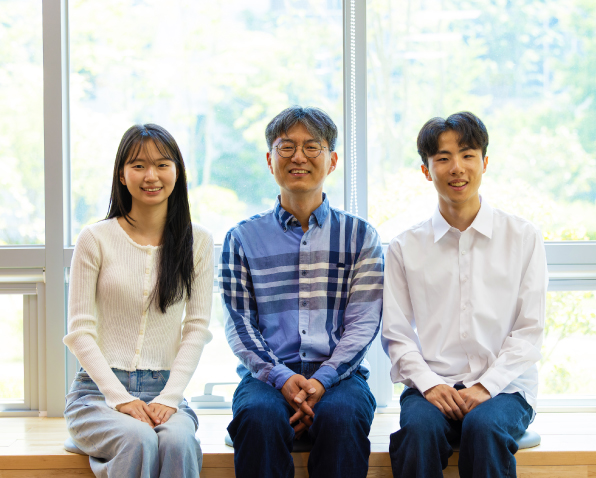
A move in a game may appear to be a simple choice, but hidden within it is a complex decision-making process that involves reading the situation and predicting what comes next. Professor Kim Kyung-joong discovered the potential for AI research precisely there and has been exploring human judgment and collaboration through games. GIST student ambassador Gionnarae met with Professor Kim to hear the fascinating story of his AI research, which began with games.
Gionnarae
As GIST’s official student ambassador group, Gionnarae promotes the university through campus tours, support for on- and off-campus events, and student-created informational content.
Could you please introduce your lab?
Our lab is the Cognition and Intelligence Lab. Among various fields of artificial intelligence, we specifically research decision-making problems related to cognition. While the elements of the cognitive process—such as memory, reasoning, and thinking— are diverse, we focus on the question: “How can we make the optimal decision?” We have chosen games as a domain in which to apply our decision-making research. By researching how AI in games assesses situations and makes decisions, we aim to contribute to the overall advancement of artificial intelligence technology.
Was there a special reason you began researching game AI?
During my doctoral program, I played games quite seriously. I was so deeply immersed that I even won a domestic Othello tournament. When you play games, you constantly find yourself thinking, “Why should I make this move?” In that process, I naturally became interested in decision-making techniques, and the thought of connecting my skill and experience in games with AI research led to my current line of work.
Could you introduce the major research achievements of your lab?
Game AI research can be broadly divided into three areas: creating AI players that excel at games, generating game content, and understanding players. A representative achievement is the in-house development of an MMORPG-based AI research platform. It is not easy to secure experimental platforms for game AI research. Commercial games do not make their platforms readily available to researchers, and creating a high-quality game from scratch requires a significant amount of time and effort. Therefore, we have developed a research-oriented game that includes the fundamental elements of an MMORPG, which we use for various studies while comparing our results with those obtained from commercial games like World of Warcraft.

I heard that you recently won an international AI game competition.
We recently won the Orak Game Agent Challenge, an international AI game-playing competition hosted by Krafton. This competition challenged participants to create general-purpose agents that could use LLMs to play multiple games. Eight of our graduate students split into two teams and experimented with different strategies. Ultimately, our winning strategy came from acknowledging the limitations of small language models and providing them with the necessary information in a form carefully organized by humans.
What kind of game AI are you developing recently?
The field I am interested in these days is cooperative game AI. For example, in the game Overcooked, two players must work together to complete a dish. Task allocation, timing, and movement planning are all crucial. Here, I am researching how well AI can cooperate when teamed up with a human. Because every person has different intentions and ways of acting, this is much more difficult than having AIs cooperate with each other. Therefore, cooperative game AI also connects to the field of Human-Computer Interaction (HCI), which explores natural interaction between humans and computers.
AI playing a game well and making it fun are two different issues; which one do you consider more important?
If AI is at the center of game AI, the game becomes a laboratory for evaluating performance. Conversely, if the game is at the center, AI becomes a tool for creating more enjoyable experiences. Personally, I put more weight on the latter. It is more important to ask whether a technology actually makes a game more enjoyable than to focus on how advanced the technology itself is.
Why can games serve as an excellent laboratory for AI research?
Human intelligence is notoriously difficult to study because it involves complex, intertwined processes of seeing, hearing, speaking, and remembering. In contrast, games offer clear goals, and the outcomes of decision-making can be evaluated relatively easily. The advantage of using games is that they allow us to focus on decision-making itself within a controlled, virtual environment.
Are there any cases where game AI achievements have been applied to real-world scenarios?
The concepts used in games can certainly be applied to real-world problems. A prime example is the field of rehabilitation. Rehabilitation is often repetitive and tedious, which can make it difficult for patients to stay motivated. By utilizing the concept of dynamic difficulty adjustment (DDA) from games, we can predict and adjust the difficulty level to suit the patient, making the rehabilitation process much more engaging. In fact, we have already conducted research that links rehabilitation exercises to the movements of game characters. Additionally, we are extending our simulation-based reinforcement learning techniques into the field of autonomous driving.

Gameplay scenes generated using an LLM-based system:
Super Mario (top left), Pokémon Red (bottom left),
StarCraft II (top right), and 2048 (bottom right)
Could you also tell us about your research in the field of robotics?
I am a researcher who crosses many boundaries. During my doctoral program, I worked on games, robotics, and bioinformatics, and as a postdoctoral researcher, I developed AI for robots in a robotics lab. After becoming a professor, I continued to research robotics AI, but I eventually shifted my focus toward games after experiencing the challenges of hardware and the limitations of interdisciplinary collaboration. In the long term, I would like to apply the research achievements I have gained from games back to robotics. Recently, I have been conducting research on fitting walkers for older adults with sensors that can detect the direction in which the user intends to move.
What do you mean by ‘Human-Centered AI’?
To put it simply, it starts from the difference between the relative lack of enjoyment people often experience when playing with AI and the pleasure of playing with another person. Even if an AI is much more skilled, the pleasure of playing with a person is different. Humans make mistakes and adjust to the opponent’s level. Ultimately, I believe human-centered AI means adapting AI technology to people so that they can interact with it comfortably and naturally.
What are the ultimate goals and long-term vision of your laboratory?
Our laboratory is not limited to games; we are researching optimal decision-making methods that can be applied across various fields. Ultimately, our goal is to find ways for AI to learn and make decisions independently through trial and error, without humans having to teach it every single step. In the long term, I hope AI will progress beyond language-centered foundation models toward vision–language–action models capable of taking action in diverse domains such as games, robotics, and autonomous vehicles.

Please share the most difficult moment you experienced during your research and how you overcame it.
During my time as a postdoctoral researcher, I spent a long time working on research into how one robot could understand and model the intentions of another, but the results did not meet my expectations. There were limitations in robotics technology, and I was left wishing I had a deeper understanding of cognitive science and psychology. Although I later shifted my focus to game AI, this field was not an easy path either. However, I believe it is important to have the perseverance to stay with a topic that you can explore deeply over a long period. That experience taught me that there are problems that cannot be solved by engineering alone, which is why I now place great importance on collaborating with students from diverse backgrounds.
Do you have any advice you would like to share with junior researchers?
Game AI and HCI are fields that offer plenty of room to connect with your own personal interests. Just as my experience with the board game Othello became a great asset, everyone has interests that can serve as a starting point for research. Being good at math or science is important, but your motivation and determination are even more critical. Once you have a goal, you will naturally find and learn the necessary skills, regardless of the field.
What are the essential skills humans must possess in the age of AI?
I still view AI as a useful tool. While the invention of electricity fundamentally transformed our way of life, the essence of being human—eating, communicating, and striving for self-actualization—has not changed significantly. Ultimately, AI is a tool created for humans. Therefore, in the age of AI, what becomes even more critical are the fundamental competencies of thinking, speaking, engaging in dialogue, and exercising creativity. It is important to use these tools to enrich our essential human activities rather than become subordinate to them.
Lastly, could you share a final word with our readers?
Game AI research might feel unfamiliar at first. However, games can certainly serve as a subject of serious and in-depth research. Even if it isn’t through games, if you have a field that you are personally passionate about, you can find new research topics within it. I encourage you to take on the challenge of exploring new fields with the mindset, “If even games can become a field of research, why not this?”
